PHILOSOPHY OF CARE | Doctors tend to view birth as being best safeguarded by medical technology and procedures. They are generally comfortable with the use of routine interventions and may actively manage labor and birth. If this approach resonates with you, a doctor-attended hospital birth could be a good fit. | If you view low-risk birth as a natural, healthy life event that is safest and most satisfying without routine interventions, you might consider birth with a midwife—whether in the hospital, in a birth center, or at home.
|
SURROUNDINGS | Some hospitals have home-like family birthing suites that are as comfortable and pleasant as midwife-led birth centers.
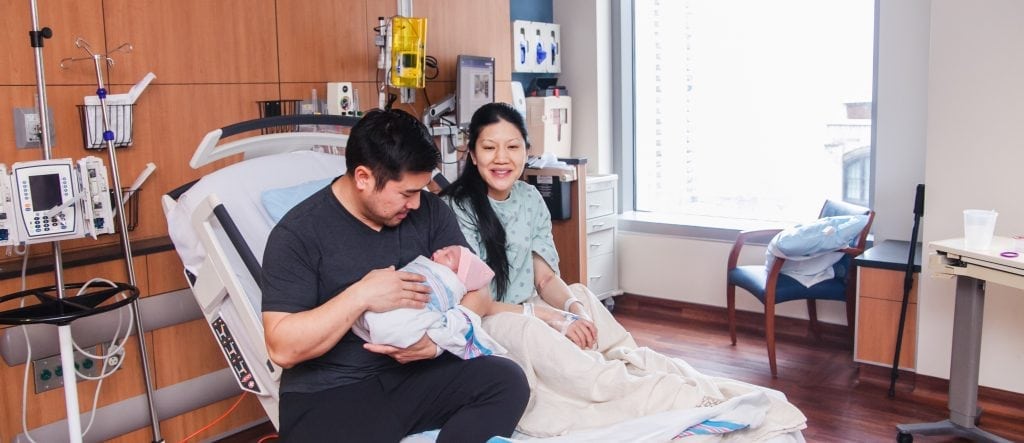
Hospitals have the technology and expertise to care for you if you develop medical complications, including operating rooms for C-sections. Most also have neonatal intensive care units (NICUs) to care for sick babies. | Your hospital room may have monitors and other equipment that give it a clinical, impersonal feel.
There is less privacy in hospitals than in other birth settings. Nurses, residents, anesthesiologists and medical students whom you've never met may come into your room, which can feel disruptive and intrusive.
Your family and visitors may not have comfortable, pleasant spaces to hang out. They will be sharing public spaces with other families. |
FEELINGS | You may feel safer and more relaxed in the hospital, knowing that hospital technology is there if you need it and a C-section is available just down the hall. Feeling relaxed and safe can make birth easier, faster, and less painful.
| Hospital rules and routines may interfere in the way you want to labor. The hospital setting may make you feel stressed, anxious, or unsafe. These feelings can make birth harder, slower, and more painful. |
MANAGING PAIN | Some hospitals provide birthing bars, rocking chairs, birth balls, or other equipment that can help you manage your pain without medication. A few offer labor tubs; laboring in water can be an effective way to manage pain. Showers are usually available.
Pain medication is available, including epidural anesthesia. | In most hospitals, you will have less freedom to move, eat and drink, take a shower, or change position than you would at home or in a birth center. This can make your pain harder to manage.
Few hospitals offer labor tubs. |
WHO TAKES CARE OF YOU | Most doctors who deliver in the hospital are OBs. OBs are highly trained physicians and surgeons. They spend the majority of their training learning how to handle complications of pregnancy and birth.
Doctors have a wider scope of practice and more years of medical training than midwives. If you are high-risk, doctors are best qualified to care for you.
| Doctors are trained in the medical model of care, which relies on routine interventions and active management of labor. If you are low-risk and are attracted to the midwifery model of care, a doctor might not be a good fit for you. |
SUPPORT IN LABOR | You will also be supported by the labor & delivery nurses.
Some hospitals have liberal policies about who can be with you during labor and delivery—for instance, family, friends, a doula, etc. | Many women are surprised when they are left to labor on their own in the hospital for long stretches of time, with their labor & delivery nurse as their primary support. Doctors have to divide their attention among a number of patients at a time. They will generally not have time to support you throughout your labor. Instead they will join you as you get close to pushing your baby out, or if they are worried that you may be developing complications.
Labor & delivery nurses in the hospital vary widely in their philosophy of birth. Some are very skilled at supporting natural childbirth, some are not.
Most hospitals limit the number of people who can be with you during labor and delivery—for instance, family, friends, a doula, etc. |
POLICIES & ROUTINES | - | You will be subject to hospital rules and requirements. There may be rules about whether you can eat or drink. You will probably have an IV. There are likely to be time limits on your labor. Continuous fetal monitoring may limit your ability to move or change position. |
INTERVENTION RATES | - | For low-risk women, intervention rates —including C-section, episiotomy, and pain medication—are higher for doctors than for hospital-based midwives. |
SAFETY | If you are high-risk, birth in a hospital with a doctor is your safest option. (See "The Research Says" below.) | Some outcomes may be better when low-risk women are attended by hospital-based midwives instead of doctors. (See "The Research Says" below.) |
CONTINUITY OF CARE | Unlike a midwife, your doctor will continue to care for you even if your pregnancy or labor becomes complicated or you need a C-section. | If your labor is very long, the shift may change and a new doctor may take over your care.
You will not meet your labor & delivery nurse until you arrive at the hospital. |
GETTING THERE & TRANSFER | You will not have to transfer to a different setting if you decide you want an epidural or if you develop complications during labor. | You will need to drive to the hospital once your labor starts. |
PRENATAL CARE | Doctors may be likely to run more prenatal tests than midwives. You may find that comforting. | Doctors have to divide their attention among a number of patients at a time. They generally cannot spend as long with you at your prenatal visits as a midwife can.
Doctors may be likely to run more prenatal tests than midwives. That might make you anxious.
|
AFTER DELIVERY | Many hospitals have updated their policies to keep mothers and babies together after birth in order to support bonding and breastfeeding.
Nurses and (sometimes) lactation consultants can help you with breastfeeding and baby care.
If you want or need time away from your baby to rest and recover, hospital staff will care for your baby in the nursery. | You may be separated from your baby for the new baby check-up. In some hospitals, babies are routinely taken to the baby nursery.
Your sleep will be interrupted by frequent check-ups.
Many hospitals do not allow fathers or birth partners to stay overnight. Sibling visiting hours are restricted. You will need to make plans for your absence.
You will usually be able to see friends and family only during set visiting hours. |
COST | Hospital birth—whether with a midwife or doctor— is generally covered by health insurance. | Birth in the hospital is generally more expensive than birth at home or in a birth center. |